Saturday, 11 January 2025

UK Wildlife Sightings, January 2025


 Despite a very wet start to the year, with snowfall and flooding elsewhere in the country, the first half of the month brought some welcome sunshine as high pressure with northerly winds brought several cold, crisp, sunny days - particularly between the 6th and the 11th. Wearing my thickest fleecy jacket and having to scrape ice off the car was a small price to pay for the chance to start my 2025 bird lists in bright weather, ideal (with the sun low in the sky) for photography. My first trip of any distance was to Welney WWT (Norfolk), where I was lucky to see Short-eared Owl, all three UK egrets, Tree Sparrows, Whooper Swans and all the common dabbling ducks. The only disappointment was to miss out on a flight of five Common Cranes, which apparently flew overhead whilst I was in one of the hides. Everybody else saw them.....


Whooper Swans, WWT Welney, 7 January


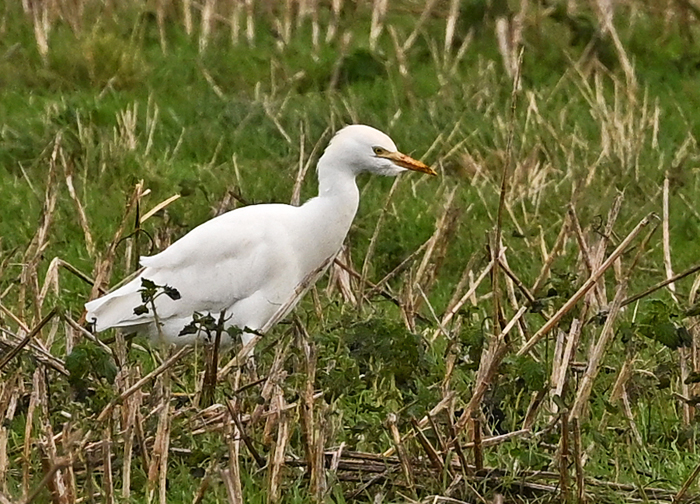
Cattle Egret, WWT Welney, 7 January


Tree Sparrow, WWT Welney, 7 January


Roe Deer, WWT Welney, 7 January

The following day saw me on the North Norfolk coast, enjoying the (somewhat hazy) sunshine at RSPB Titchwell Marsh and Thornham Harbour. Sightings at Titchwell included Spotted Redshank, a roosting Tawny Owl and Common Scoters on the sea. I also had close views of Red-breasted Merganser (males and females) on the Tidal Marsh, but the star birds for me were a pair of Bearded Tits, which provided stunning views from time to time as they fed on Reed Mace about 30 feet away. Fortunately, I was eventually able to get a couple of decent photos of the male (see image below). Brent and Pink-footed Geese, a Barn Owl and a wintering Greenshank were seen in failing light at Thornham Harbour.


Female Red-breasted Merganser, RSPB Titchwell Marsh, 8 January


Male Red-breasted Merganser, RSPB Titchwell Marsh, 8 January


Male Bearded Tit, RSPB Titchwell Marsh, 8 January

The weather stayed dry, but more cloudy from the 12th onwards. Reports from Abberton Reservoir (near Colchester) had suggested that several semi-rare birds were to be seen there, so I visited on the 14th, viewing from five separate points (Lodge Lane viewpoint Peldon, both causeways, the visitor centre hides and the Billets Farm viewpoint). I was lucky to see three Bewick's Swans and a couple of Ruff from Lodge Lane, whilst two Slavonian Grebes, at least eight Black-necked Grebes and several Goosander showed well from the Layer De La Haye causeway (some images below). The visitor centre hides (eventually) yielded a first winter Caspian Gull and my first Stonechat of the year, as well as more Black-necked Grebes, whilst probably my best sighting of the visit, a Black-throated Diver, was seen from the Billets Farm viewpoint. Birds that I didn't see included Smew, Scaup, the Canvasback and Great Northern Diver. If I had seen all of those, it would have really been a day to remember!


Black-necked Grebe (back left) and two Slavonian Grebes, Abberton Reservoir, 14 January


Two Slavonian Grebes, Abberton Reservoir, 14 January


Male Goosander, Abberton Reservoir, 14 January

I went back to Norfolk on the 21st, visiting four locations: Old Hunstanton, where I again saw the wintering Glaucous Gull, Thornham Harbour (Rock Pipit), Holkham Bay (Shorelarks) and finally Warham Greens, where I saw Barn Owl, Short-eared Owl and a 'ringtail' Hen Harrier, but there was no sign here of the wintering Pallid Harrier. For once, I missed out RSPB Titchwell!


Glaucous Gull, Old Hunstanton, 21 January


Shorelark, Holkham Bay, 21 January


Rock Pipit, Holkham Bay, 21 January


Pink-footed Geese flying in to Roost at Sunset, Warham Greens, 21 January

A glorious day was forecast for the 30th, so it was back to North Norfolk for another full day visiting five sites. I started at Lynford Arboretum, which was rather disappointing and surprisingly failed to yield any Marsh Tits, Bramblings or Hawfinches. I went on to the coast at Sheringham (lots of Turnstones but no sign of Purple Sandpipers). Things improved up the coast at Weybourne, where a very large flock of Pink-footed Geese incorporated at least four Russian White-fronted Geese and two Tundra Bean Geese (the latter a species that I didn't see at all in 2024). As a bonus, I had two sightings of a Merlin in flight here. I stopped briefly at Stiffkey, but failed to see the reported Glossy Ibis despite searching for half an hour, before moving on to (you guessed it!) RSPB Titchwell, where I spent the rest of the day photographing birds on the beach and Tidal Marsh in beautiful light. Some of my photos from the day are below.


White-fronted Goose (front, centre) with Pink-footed Geese, Weybourne, 30 January


Male Pintail, Tidal Marsh, Titchwell, 30 January


Redshank, Tidal Marsh, Titchwell, 30 January


Bar-tailed Godwit Preening, Titchwell Beach, 30 January


Monday, 16 December 2024

Local Wildlife Sightings December 2024

 I was on holiday until the 4th and didn't get out until the 6th, when my walk around the villages produced 44 species recorded (39 seen). Highlights were arguably a pair of Green Woodpeckers (seeing any locally has been difficult in the last couple of years), a Raven and two Herring Gulls just up the road at the Newsells Stud Farm. The regular two pairs of Coot were at the two ends of Phillup's Lake. A new female Tufted Duck was present, together with 20 Mallard.

The weekend saw a storm pass over Royston, with what I reckon were severe gale force winds overnight on the 7/8th that necessitated emergency repairs in the dark to the (new!) fence to prevent panels being lost. Annual rainfall passed 30 inches for only the second time since I started keeping records in 1991 and the drizzle in the following, gloomy week was sufficient for a new rainfall record to be established - hardly a surprise after such a wet year. Coming back from town at dusk on the 9th I saw a Tawny Owl fly into the Green Walk Plantation close to the house: an unusual sighting at this time of year.

On the 13th a walk along the Icknield Way, east of Royston, produced at least 34 species, including a Stonechat near the Heydon Grange golf course and no fewer than three Sparrowhawks, one carrying prey (a Blackbird?). I say 'at least 34' because I'm never too sure how many gull species I have seen - in particular, were any Yellow-legged or Caspian Gulls in amongst the Herring Gulls? The normally huge gathering at Heydon Pig Farm had been disturbed, but there were plenty to see along the way including around 200 (mainly) Common Gulls following the plough. As usual, I photographed those gulls that were close enough to the track to (hopefully) identify later. One of my images (below) showed an adult gull with many of the characteristics of Caspian Gull ('gimlet' dark eye, long, thin bill with markings only on the lower mandible, very clean-looking). Is it too small, though, and is the back too dark? Gull identification can be tricky and frustrating, but also fun at times, even for this non-expert. Hopefully I'll keep learning.........


Possible Caspian Gull (on the Ground, 2nd from Right) with other Gulls, near Royston, 13 December

On my way back from Fishers Green on the 15th (see my UK blog) I popped in to Amwell to see the resident female Smew, which was (distantly) feeding when viewed from the Gladwin Hide. Also present were one male and at least two female Goldeneye and an uncommon visitor to Hertfordshire, a Great Black-backed Gull.


'Record Shot' of Female Smew, Amwell GP, 15 December

I made my first ever visit to Admirals Lake, east of Hoddesdon, on the 19th to see a Black-necked Grebe. The grebe was easy enough to see, but always stayed on the (inaccessible) far side of the lake, making photography very difficult. In the end, I just kept one 'record shot', which is shown below.


'Record Shot' of a Black-necked Grebe, Admirals Lake, Hoddesdon, 19 December

Local walks in the second half of the month were uninspiring. The main highlight of another walk around the villages on the 20th was a large flock of Golden Plover (est. 350 birds), wheeling around in flight to the north of Therfield village - the biggest flock that I've seen here for years. I watched them for at least 20 minutes and they showed no sign of landing in that time, perhaps discouraged by not one but two local 'shoots'. A pair of Ravens (becoming increasingly common locally) was also seen in flight, whilst five Tufted Ducks were on Phillup's Lake. Ravens were also seen on a visit to Scales Park on the 23rd, but there was no sign of Marsh Tits on this occasion. Also on the 23rd I walked up the Icknield Way at dusk, looking for owls and (for once) was rewarded with the sight of a Barn Owl, hunting at Greys Farm.


A few of about 350 Golden Plovers, in flight near Therfield Village, 20 December


Four of Five Tufted Ducks at Phillup's Lake, Reed End, 20 December

With Christmas festivities, etc. intervening, that was pretty much it for 2024, although there was a surprise on the 31st, when a female Brambling appeared in the garden, making this the 78th bird species seen on my Local Patch (two mile radius of the house) in 2024. Despite the late entry, this is the first time that I have seen fewer than 80 species annually since 2011, reflecting perhaps my failing abilities but also the loss of several previously common (breeding) species, Lapwing being the most obvious absentee this year. The poor weather in 2024 may also have been a factor: rainfall, at 30.6 inches (778mm) broke all previous garden records and there was a notable shortage of sunshine throughout, but particularly in the last three months of the year. Surely 2025 must be better!?


UK Wildlife Sightings December 2024

 I made visits to Fishers Green lakes in Essex, part of the Lee Valley complex of nature reserves, on the 11th and the 15th. The first visit was to do a reconnaissance visit for the trip that I was leading for the RSPB Local Group on the 15th, and was carried out in the ultimate of dull, gloomy weather. Highlights were sightings of a Water Rail and three Goosander, the latter having likely strayed over the Hertfordshire border from their usual site on Ashley Lake. Thankfully, the weather was better for the Local Group visit on the 15th and we saw Kingfisher, Peregrine and the 'Fishers Green Black Swan', as well as the ubiquitous Water Rail, which was seen from the rather splendid new hide that has been tagged on to the Bittern Hide (where I saw my first ever Bittern, but that's another story). 


Blue Tit at the Bittern Hide Feeding Station, Fishers Green, 15 December


Male Goosander, Fishers Green, 11 December

Poor weather, the proximity of Christmas and much catching up to do after my recent holiday meant that I only made one more bird watching trip of any note in December - and that just an afternoon visit to Old Hunstanton in Norfolk on the 17th to see an immature Glaucous Gull, the 242nd and last addition to my 2024 UK list. The bird had been feeding on a dead seal for some days (and continued to do so for several more days afterwards), although it had been disturbed when I visited and landed quite close to me on the shingle bank, before taking off and allowing me some flight photographs on a very dull day (dullness having been a notable feature of the last three months of the year). I was lucky to also see and photograph five Shorelarks on the same stretch of shingle.


Immature (1st Winter) Glaucous Gull, Old Hunstanton, 17 December


Glaucous Gull in Flight, Old Hunstanton, 17 December


Shorelark, Old Hunstanton, 17 December


Friday, 13 December 2024

Bird Watching Trip to The Gambia, 21 November to 4 December

I escaped the gloom of the English winter for the sun and heat of The Gambia on my first overseas bird watching trip (with Naturetrek) since Japan in January 2023. The Gambia is a very small West African country, surrounded by Senegal except for its small Atlantic coastline. Situated 14 degrees north of the equator, and on the same latitude as the UK (so no need to change the clocks and no jetlag), it has become popular with Europeans wanting beach holidays in guaranteed sunshine. However, for many reasons The Gambia is also one of the world's 'go to' places for bird watchers. It is small and compact and the great variety of habitats hold a huge number of different bird species, with 250+ expected on this 11 night holiday. The main geological feature of this long, thin country is the huge Gambia River, which winds its way right across the country before entering The Atlantic. The dominant (90%) religion is Islam, with the remainder of the people being Christian. The Gambia is a relatively poor country and its economy relies heavily on tourism.

An early flight from Gatwick meant that we were established at a hotel close to the sea in time to do some bird watching from a bridge over a small tidal channel, just a few hundred yards from the hotel (where, due to a problem with another wildlife company that will remain nameless, I was without a room for several hours and had to lug a very heavy rucksack around with me) and this provided what for me was the photographic highlight of the holiday, with perfect light and plenty of exposed mud allowing some good photographs of many waders and other water birds, some new to me, with around 45 species seen during a 90 minute visit. We were very lucky with the tide, because on all subsequent visits to the bridge little or no mud was exposed and much smaller numbers of birds were seen.


Senegal Thick-knee, The Gambia, 22 November

We stayed at the hotel for three nights, with the following two days providing a huge variety of birds. On both days I saw more than 100 species, and I missed quite a few! It was breathless stuff and, whilst at home I may be considered an 'expert' when leading walks for my RSPB group, here I was very much in the 'novice' category, and on several occasions needed the help of the leader, Chris, or the guide, Tamba, to get my binoculars on to the birds.

After leaving the hotel we headed east into the interior, following the river and spending one night at the Tendaba camp and then three nights at the Bansang camp, still further up river, which involved an interesting ferry crossing. The camps were, as expected, pretty basic with no hot water at Bansang, but air conditioning (necessary, as daytime temperatures reached 37C) was available throughout. Bird watching was consistently intensive, with frequent stops on the road as interesting species were spotted, necessitating clambering in and out of a rather cramped minibus. A fellow client, James, was becoming our ace bird finder, with one of his discoveries (a male Painted Snipe) becoming one of the birds of the holiday. For me, there were so many new species seen that the only way of assessing their rarity was by listening to how many times Chris uttered the words "Oh, my God" after they had been found. It is difficult for me to choose a favourite bird of the holiday, but the Red-throated Bee-eaters (image) were exceedingly pretty.


Red-throated Bee-eater, The Gambia, 26 November

Whilst the emphasis of the holiday was firmly on birds, mammals, reptiles and amphibians were not ignored. Monkeys included Green Vervet (seen on several occasions), Guinea Baboons (seen by the roadside), Patas Monkeys and (my favourite) West African Red Colobus. Striped Ground Squirrels were seen regularly, but the mammals of the holiday were two Fire-footed Rope Squirrels, which neither Chris nor Tamba had seen before. A mongoose was seen by some and Gambian Epauletted Fruit Bats as well as Mauritian Tomb Bats made up the supporting cast. Hippopotami, Jackals and Hyenas eluded us whilst the only 'big cat', the Leopard, is so rare in The Gambia that our chances of seeing it were practically nil.


West African Red Colobus Monkey, 28 November

Skinks, agamas and lizards were regularly seen, with enormous Nile Monitor Lizards being encountered on both our boat trips along the river and its side channels. West African Crocodiles were only encountered once before the penultimate day, when we had lunch at a river camp in the Marakissa region. The owner, a lovely lady whose daughter is a Hollywood actress, called three largish crocodiles out of a nearby lake, allowing us to see the large bodies that were joined to the friendly looking heads that had been bobbing about in the water when we arrived. They're just big pussy cats really!


The Crocodile Lady with her Pets, 2 December

The Gambia is a great place to go to see butterflies, with a list of  around 250 species. There wasn't much time for butterfly photography on this trip, although I did manage to snap a few species around the hotel towards the end of the holiday, and when we were out and about looking for (but not finding) birds. The commonest butterfly by far was the African Caper White, which was similar in size and pattern to our Marbled White. This species reached almost plague proportions in and around the hotel on the first night of the trip and was ever-present throughout the holiday. I reckon that I photographed 15-20 species, but it will be some time before I identify them all. The photo below is of one of the prettier ones.


Gambian Butterfly, 24 November

Dragonflies, mainly of the 'darter' type, were also much in evidence, with some having exotically patterned wings. Only a handful of different species were found, which I will try to identify later.

 We returned to our hotel, having spent a further night at Tendaba camp, for the final three nights. The bird list continued to swell, reaching a final total (I think) of 284, of which I saw all but ten. I was a relatively quiet part of a very lively group, who all got on very well. Indeed, Tamba said at our final dinner that we were the best group that he had ever guided, and I think that he meant it sincerely! For my part I had one or two health and other issues to deal with on my return and, partly as a result, I never slept well. By the end of the holiday I was completely exhausted, so I'm very grateful to everyone in the group for helping to lift my spirits during the daytime, as well as the people and fauna of The Gambia for making this such a memorable visit.



Sunday, 10 November 2024

Local Wildlife Sightings November 2024

 Late October saw a dramatic change in our weather. It actually stopped raining! As I write, on 10 November, we haven't seen any meaningful rain (just some drizzle) since 21 October, nearly three weeks ago. This represents, by some distance, the driest period for well over a year. That is the good news. The bad news is that the weather has been DULL. The sun was last seen on the afternoon of 30 October and since then, barring the occasional glimpse of blue sky through the gloom, Royston seems to have been living in perpetual dusk. Sunshine is promised for tomorrow, but for now we live on in the longest period of gloom that I can recall.

I had to go in to Stevenage on the 4th and took the opportunity to visit the Fairlands Valley Lakes, hoping to see the hybrid Caspian Gull 'X307', which is a regular winter visitor. There was no joy there, but plenty of gulls and other water birds were on display and I spent a pleasant 30 minutes photographing them and other birds. At one point a Common Gull found a potential food item (I'm not sure what it was - possibly some discarded rubbish) and was chased around the main lake by other gulls before dropping it. A Black-headed Gull picked it up and was immediately pursued by the Common Gull. I think that this is just a little game that the gulls play, without necessarily being interested in eating whatever they find!


Common Gull with Food (?) being chased by an immature Lesser Black-backed Gull, Fairlands Valley Lakes, 4 November


Cormorant at Fairlands Valley Lakes, 4 November

On the 5th it was time for another walk around the villages. By now, all the summer visitors and passage migrants had gone (no Chiffchaffs recorded), but winter visitors had arrived and I saw my first Fieldfares of the autumn in the Therfield area. Finches and buntings were much in evidence, particularly in the Therfield area where I estimate that around 450 Linnets (two very large flocks and a few smaller ones) were seen, as were an estimated 70 Yellowhammers and 25 Chaffinches, the last almost certainly migrants from Northern Europe, as I've hardly seen any locally in the spring or summer. Phillup's Lake harboured another unusual female Tufted Duck, with a strange head shape and no tuft. Perhaps I keep finding anomalies with these birds because, with them appearing on my local patch, I study them more carefully than I would (say) the large numbers that occur on lakes elsewhere in Hertfordshire. Two Ravens flew across the Icknield Way, but the biggest surprise on my walk was to hear the familiar raucous calls of at least one Ring-necked Parakeet on the far (south) side of Therfield - a new record for me in my local area, although they have been recorded by others before (and were recorded in Royston on the same day). Was this/these bird(s) a pioneer of an invasion, or just wildly off course? Time will tell.


Female Tufted Duck with an unusual Head Shape, Phillup's Lake, Reed End, 5 November


Toadstool Photographed near Therfield, 5 November

A morning and early afternoon walk on the 8th, eastwards along the Icknield Way from the main A505 layby to Heydon Pig Farm and back, produced nearly 40 bird species recorded, including a flock of 24 Corn Buntings and more Fieldfares. A huge flock of gulls (the vast majority Lesser Black-backed) was loafing at the pig farm (image of some below). I couldn't pick out any rarities. I have mentioned before that a gull expert told me that all the larger gulls pass through our area as they head to or from warmer climes in the winter and that they do not over-winter here. I beg to differ, as there are hundreds of gulls at Heydon Pig Farm throughout the winter. Perhaps the recent warmer winters have encouraged these gulls to over-winter in the UK, rather than heading further south.


Just some of the Gulls loafing at Heydon Pig Farm, 8 November. A Little Egret (Centre Foreground) and a few Mallard Ducks (Foreground) can also be seen.


Fieldfares and Corn Buntings near Flint Cross, 8 November

The sun finally reappeared late on the 10th and showed off and on for the rest of the month. I started feeding the birds in the garden again in late October, using an expensive squirrel-proof feeder that actually worked! Now the squirrels just hang around underneath the feeder, alongside the pigeons (feral birds and one or two Stock Doves have reappeared), waiting for food to drop down. The feeder (which is filled with sunflower hearts and dominated by Goldfinches and Greenfinches, together with one or two Chaffinches) proved very popular during the dull days, with birds fighting to get to the four slots, but less so when the sun appeared. Robins, Wrens, Blue Tits and Great Tits were much in evidence and on the 20th I had a visit from two Song Thrushes, the first time that I've seen more than one in the garden. A very noisy (and close) Tawny Owl was heard outside on the evening of the 17th, after the first significant rain of the month. Coincidentally (or not) one or two Common Frogs were seen after dark in the back garden, enticed out by the rain and still looking for food when they should have been hibernating!

Away from the garden, a Stonechat was seen in Therfield on the 10th, my first local sighting for several months. A 'cold snap' from the 19th, accompanied by wintry sunshine, enticed me out to do another walk round the villages on the 20th. November seems to be a good month locally for both quality and quantity of birds: I've found and/or seen Rough-legged Buzzard, Short-eared and Long-eared Owls, Hen Harriers and Great Grey Shrikes in the halcyon days of past Novembers. Nothing particularly exciting happened on this walk, but I did see a Grey Wagtail at Hatchpen Farm (a first for this site) and a male Common Pochard at Phillup's Lake, with the lake also housing a Tufted Duck, a Little Grebe and two pairs of Coot, which are now resident on the lake. A total of 47 species recorded (44 seen) was my best for some time.


Fieldfare, Therfield, 20 November


Male Common Pochard, Phillup's Lake, Reed End, 20 November

I was on holiday in The Gambia (West Africa) from the 21st I'll attach a brief trip report in mid December.


Saturday, 9 November 2024

UK Wildlife Sightings November 2024

 I spent an afternoon at RSPB Lakenheath Fen on the 1st, looking for Water Pipits and Common Cranes. A single Water Pipit was heard, but not seen, near the Joist Fen viewpoint. Also seen were three Whooper Swans, four Great White Egrets and at least two Marsh Harriers on a quiet day.

 
Two Whooper Swans and a Great White Egret on Washland, Lakenheath Fen, 1 November

My quest for cranes continued on the 6th, when I drove up to Willow Tree Fen, north of Peterborough, where Common Cranes had been regularly seen coming in to roost. I hadn't been to Willow Tree Fen for about 15 years and was surprised to find that, whereas before I had been able to walk out onto the fen, I was now restricted to a car park with a viewpoint looking out over the fen. However, that was all that I needed as 25 Common Cranes came in to roost at dusk, with several Marsh Harriers (including a leucistic individual) and seven Cattle Egrets also seen from the viewpoint.


Record shot of some of the 25 Common Cranes that roosted at Willow Tree Fen on 6 November

Staines Reservoirs have proved a happy hunting ground over the years, and particularly last winter when I had great views of some of our rarer grebes and divers. News of a Lapland Bunting on the causeway between the north and south reservoirs enticed me to visit again. I arrived on the 7th to find the bunting hopping on the causeway almost at the feet of the assembled birdwatchers (I suspect that somebody had put food down for it here). I knelt and waited as it came towards me, getting so close that I couldn't focus my camera on it! My images don't do justice to this characterful little bird, which is still present at the site as I write this on the 9th. Further along the causeway I counted five Black-necked Grebes on the South Basin. It is unusual not to see this species here during the winter months and they are sometimes joined by Slavonian Grebes.


Lapland Bunting, Staines Reservoirs, 7 November


Lapland Bunting, Staines Reservoirs, 7 November


Three Black-necked Grebes, Staines Reservoirs, 7 November

On the 12th I made another visit to the North Norfolk coast, spending time at Thornham Harbour before moving on to Titchwell. Once again I had a glimpse of a Water Pipit as it flew in front of the Parrinder Hide, uttering its distinctive, sharp, one note call. Several Meadow Pipits were also around. One pipit seen from the Parrinder Hide had a very distinctive eye ring, which didn't fit with any pipit species! I've included a somewhat pixellated photo of the bird below (it was a long way away). I assume that the bird is a Meadow Pipit. Fourteen wader species, including Ruff, were seen on the day.


(Meadow?) Pipit (nearest bird) with Conspicuous Eye Ring, RSPB Titchwell Marsh, 12 November


Eleven Little Egrets, RSPB Titchwell Marsh, 12 November


Sanderling on Titchwell Beach, 12 November

An RSPB coach trip on the 17th saw us spending the day at Rutland Water (Egleton Reserve). Slavonian Grebe, Great Northern Diver, Cattle Egret, Kingfisher and Scaup were amongst the species seen. Several Great Egrets were present on the reserve and two appeared to be courting, walking close together with bills pointing to the sky - behaviour that I haven't seen before. I took some photos at an angle through glass, which didn't come out at all well, so I'll include a more conventional image below.


Great Egret, Rutland Water (Egleton Reserve), 17 November


Blue Tit near the Feeding Station, Rutland Water (Egleton), 17 November

I left the UK on the 22nd for a wildlife holiday in The Gambia (West Africa). I will get back to writing my blog posts when I've recovered, in mid December.