Tuesday, 8 July 2025

Local Wildlife Sightings, July 2025

 Back from holiday early on the 3rd and with an enormous amount of sleep to catch up on, I nevertheless managed a short evening walk on the same day along the Greenwich Meridian Trail, south of Royston, where I knew that I would find hundreds of Essex Skippers. Most had clearly been on the wing for a few days and were looking rather ragged, but I did manage to get a few photos of decent specimens in what is a very large colony. As expected, Chalk Hill Blues and Gatekeepers had emerged (the first Chalk Hills were reported on the 25th of June, the day I left the UK). Marbled Whites were still flying on The Heath when I visited on the 4th. Chalk Hill Blues were seen in relatively small numbers, but very large numbers of Gatekeepers were seen. The first of the second generation of Brown Argus were already on the wing, very early but in line with other butterfly species that have emerged early in what promises to be a long, hot summer.


Essex Skipper, Royston, 3 July


Brown Argus, Therfield Heath, 4 July


Male Chalk Hill Blue and Hoverfly on Knapweed, Therfield Heath, 4 July

A visit to Phillup's Lake on the 7th was rewarded by seeing families of four Little Grebes and three Coots. A handful of moulting Mallards and a single female Tufted Duck were also present. Nearby, I saw my first local Small Copper butterfly of the year, as well as an Emperor Dragonfly and several Common Blue Damselflies. As I reached three score years and ten, two more birthday related holidays kept me (happily) away from my local patch, so sightings were very sporadic until the 20th. However, I did manage visits to The Heath (Old Rifle range area) on the 12th, where I saw my first local Small Copper of the year, and Hertford Heath, where I saw Purple Hairstreaks flitting around in various Oak trees. The ponds had almost completely dried up and dragonflies were scarce here.


Female Chalk Hill Blue, Therfield Heath, 12 July


Small Copper, Therfield Heath, 12 July

On a visit to Fox Covert on the 14th I was very pleased to encounter an admittedly rather battered male Silver-washed Fritillary, the first that I have seen here since 2023. This species, which only arrived in the woodland a few years ago, is struggling to survive here in habitat that is not ideal, but will likely have bred here in 2024 (or maybe this male arrived from another colony this year?). Also seen in the woods were single Common and Ruddy Darters, the latter having a split and twisted abdomen, perhaps caused on emergence from the chrysalis.


Ruddy Darter with Damaged Abdomen, Fox Covert, 14 July


Record Shot of a rather battered male Silver-washed Fritillary, Fox Covert, 14 July

Following another holiday (see my UK blog) I was finally home for more than a couple of days from the 20th. The weather had finally deteriorated into what for many years was a typical English summer (thunderstorms, showers and longer periods of rain, average temperatures) and there was plenty to catch up on at home, but I did manage a few visits to local sites and, strangely, had my best week of the summer for local wildlife photography. Several female Chalk Hill Blues were now on the wing, and I photographed four mating pairs during the following week, including two pairs that were almost side by side at the bottom of Church Hill. Common Blues were also seen mating, whilst the dominant species on the wing, certainly on The Heath, was still Gatekeeper. On the 21st I led a Royston Photographic Society wildlife photography session on The Heath, near the Therfield Road, where in addition to lots of Chalk Hill Blues being seen, we found mating Burnet Moths and a large, female Wasp Spider!


Mating Chalk Hill Blue Butterflies, Therfield Heath, 22 July


Mating Common Blue Butterflies, Royston, 21 July


Mating 6-Spot Burnet Moths, Therfield Heath, 21 July


Female Wasp Spider, Therfield Heath, 21 July


Two Roosting Male Chalk Hill Blues, Therfield Heath, 22 July

Lizard Orchids

Back in the middle of June, two Lizard Orchid plants were found just off the Old Rifle Range (Nick Keep). This is, as far as I am aware, the first time that this species of orchid has ever been seen on Therfield Heath, although it is possible that they may have been here before without anybody noticing. I was asked not to publicise their appearance, as they are an uncommon plant and there was a risk of them being (unwittingly or maliciously) damaged. However, I did take some photos of the plants (one appears in the August issue of 'The Listing', where some of my butterfly photographs can also be seen), a couple of which are shown below. Lizard Orchids are particularly large orchids, which don't (in my eyes) look particularly attractive. However, they are a great addition to the flora of The Heath - I wonder whether any will appear next year? At the time of writing (30 July) the plants can still be seen, although they are wilting and decaying.


The two Lizard Orchids, Therfield Heath, 17 June


Detail of the flowers of one Lizard Orchid, Therfield Heath, 17 June

During the final week of July I concentrated, when I could, on photographing (mainly) roosting Chalk Hill and Common Blues, both on The Heath (Old Rifle Range) and at Clothall Common near Baldock, where the colony is doing well (I estimate that 200 - 250 individuals were roosting there when I visited on the 30th). I was hoping to find some aberrant individuals, but it seems that nowadays all Chalk Hill Blues look the same (well, obviously males and females differ and their colour changes with age). Here are a few more images. Incidentally, I have been asked to spell 'Chalk Hill' as two words, rather than the one 'Chalkhill' word that is in my butterfly identification books - don't ask me why!


Male Chalk Hill Blue, Therfield Heath, 29 July


Male Chalk Hill Blue resting on Scabious Flower, Therfield Heath, 29 July


Two Female Chalk Hill Blues, Therfield Heath, 29 July


Two Male Chalk Hill Blues, Therfield Heath, 29 July

Towards the end of the month, a number of pristine looking Painted Lady butterflies were seen in the Royston area. These would be the offspring of butterflies that flew across from the Continent in the late spring. Some were seen feeding voraciously on a variety of nectar, preparing themselves for the long journey back to Southern Europe, which they undertake in the late summer and early autumn.


Painted Lady, Royston, 31 July

Swift Survey

Every year I carry out an unofficial survey of the swifts in Royston town centre. The best time to do this is in late July, when the young birds have fledged but before the birds begin their migration back to Africa in early August. The best (only?) time of day to carry out the survey is in the 40 minutes or so before dusk, when the birds descend and form 'screaming parties' over the town, so I have to work quickly! I can only get a very approximate figure, because the birds are flying around rapidly, in groups of up to 15 which can splinter and re-form. However, they do tend to stay close to their breeding sites which makes my job somewhat easier. This year my rough estimate was of 85 birds, similar to last year. I report my findings to the BTO ('Birdtrack'). I have to say that I really enjoy seeing Swifts flying around like this - they appear to be so happy! I hope that they will return in good numbers next year.


UK Wildlife Sightings, July 2025

 I was away from Royston on three separate holidays from late June until mid July. The first holiday was a 'Naturetrek' holiday to North Macedonia, which I will write about in a separate blog post, when I have finally finished editing and sorting out over 200 images. I would have done this sooner, if I hadn't been on two further, shorter holidays to Wales and then Stockholm in July. From a wildlife point of view these were very low key - I'll deal with them briefly here.

Wales

My partner and I visited Aberystwyth in early July, as part of a family holiday (we met up with my brother and his family). Rock Pipits was seen around the castle ruins and I also saw Dipper and Red-breasted Merganser nearby. Aberystwyth is well known for its winter Starling murmurations around the pier, but of course we were six months too early (or late) to see these.


Young Rock Pipit, Aberystwyth, 8 July

Stockholm

For my 70th birthday my lovely partner booked a surprise four night holiday for us in Stockholm (I knew I was flying somewhere, but not to where). This beautiful Swedish city, situated on an island archipelago, held a few minor surprises. For one thing, the gulls threatening to steal your fish and chips were not Herring Gulls, but Common Gulls! Lesser Black-backed Gulls would then steal from the Common Gulls. A few Herring Gulls and Black-headed Gulls were present, but these kept themselves to themselves. The only (feral) geese that I saw were Barnacle Geese (and lots of them). Other sightings included Common Terns and a single Common Redstart. Stockholm, and Sweden in general, is very expensive (not that it bothered me, because my partner was paying for everything!), but if you can afford it and don't mind missing out on the excitement of bird watching for a few days, it comes highly recommended. Most Swedes speak good English, too. Don't fly British Airways, though - they cancelled our return flight....

Back to the wildlife, and on my birthday itself we used public transport to Hammersmith and walked along the Thames to spend an afternoon at WWT Barnes, encountering a variety of hoverflies and a Jersey Tiger Moth on the way.


Hoverfly Volucella zonaria, Barnes, 13 July


Jersey Tiger Moth, Barnes, 13 July

The reserve itself was pretty quiet - most of the wildfowl collection were moulting - but I did add three Odonata (Small Red-eyed Damselfly, Willow Emerald Damselfly and, best of all, Lesser Emperor Dragonfly) to my year list. At least two Lesser Emperors were buzzing around the many pools, but sadly they never settled for me to take their photograph, so you will have to make do with the other two. Lesser Emperors are slowly establishing themselves in Southern England (climate change?), and can be distinguished in flight from the Emperor Dragonfly by their slightly smaller size, duller colouring and a pale band around the abdomen, close to the Thorax.


Small Red-eyed Damselfly, WWT Barnes, 13 July


Willow Emerald Damselfly, WWT Barnes, 13 July

On my return from Stockholm, my next significant sortie was to Aston Rowant on the 23rd, with my target being the rare Silver Spotted Skipper butterfly. On a very dull day the reserve was very quiet, with few butterflies on the wing, but I did manage to find at least one Silver-spotted Skipper (image below).


'Record Shot' of Silver-spotted Skipper, Aston Rowant NR, 23 July

On the 25th I treated myself to a day out in Norfolk, my first visit to the county for some time. My first stop was at WWT Welney. The Wood Sandpiper, reported the previous day, had gone but I did enjoy watching a Common Tern trying to feed a fish to its chicks, which totally ignored it although a nearby Ruff took an interest. I added Brown Hawker to my 2025 dragonfly list here. I travelled on to Dersingham Bog, which was predictably rather short of water, but I did see a single male Black Darter and a single male Keeled Skimmer here. Better still, after having failed to see any here for quite a few years, I also had a couple of sightings of Grayling butterflies in flight. Once disturbed, these butterflies head rapidly for the nearest tree and hide on the trunk, where they are very hard to find.


Immature Male Black Darter, Dersingham Bog, 25 July

Encouraged by these sightings, I headed on to Snettisham, which proved to be my final stop. I hoped to see Turtle Doves here, but had no joy searching for an hour in the Coastal Park, where I have seen them many times before. With the tide coming in, I decided to head south along the muddy beach towards the RSPB reserve. Ringed Plovers were much in evidence and, as I approached the reserve, some impressive wader murmurations were seen. A huge flock of (mainly) Sandwich Terns was resting on the beach, close enough to pick out individuals with my binoculars and camera, but not close enough to be certain about identifying some of the smaller terns that were sitting alongside the hundreds of Sandwich Terns. Quite a few Common Terns were present, as were one or two Little Terns. I'm pretty sure that a handful of Arctic Terns were present too, based on bill size, colour and shape, but I could not convince myself to put them on my year list.


Terns and a Black-heade Gull at Snettisham, 25 July. Is the nearest bird an Arctic Tern??


More Terns at Snettisham, 25 July, with another possible Arctic Tern centre front

As the tide came in further, things got even more interesting as hundreds of waders flew in closer and closer. These turned out to be mainly Dunlin and Sanderling (are Sanderling, like Knot, on The Wash all year round?). A single Curlew Sandpiper was amongst them: these birds were heading for the southernmost lake on the RSPB reserve, where a White-rumped Sandpiper and a Pectoral Sandpiper had been reported on the day (and, indeed, for the remainder of the month). On a hot day, I didn't have the energy to go further but a couple of surprises awaited me as I turned to go back. Firstly, I heard the unmistakable purring of a Turtle Dove, which eventually revealed itself after much searching. Then, I noticed a family of warblers moving about in a line of bushes and sometimes coming out on to the ground to feed - a family of Lesser Whitethroats! I've never had such good views of this species before - the birds looked quite tame. Of course I took some photos: I may never have such a good opportunity again. To complete the day, several Wall butterflies were flying about in the same area. This double brooded butterfly became extinct in Hertfordshire many years ago, and Snettisham is probably one of the closest places to home where they can still be reliably seen. What a day!


Adult and Juvenile Lesser Whitethroats, Snettisham, 25 July


Record Shot of a Wall Butterfly, RSPB Snettisham, 25 July


Thursday, 5 June 2025

Local Wildlife Sightings June 2025

 After an impressively warm and sunny spring, it was back to changeable weather in June with a few warm, sunny days interspersed with showers and longer periods of rain. I took the opportunity on the 2nd (a warm, sunny day) to visit local fields and Therfield Heath, looking mainly for butterflies. Numbers of first generation Common Blues and Brown Argus butterflies were falling now on The Heath, whilst I failed to find any Adonis Blues there. However, on the small wild flower patch in the field that is behind our estate, which has proved quite productive in the past, I was lucky to find a recently emerged male Common Blue, which flew conveniently towards me and perched on top of a flower bud, allowing me to take some nice photos. If only all insects were so obliging!


Male Common Blue Butterfly, Royston, 2 June

After changeable weather in the first week, high pressure built again with plenty of sunshine and temperatures building to a climax between the 18th and the 21st, with an official heatwave and a maximum temperature in Royston of 31C (or possibly higher - I'm relying on the temperature gauge in the car!). It has been a disappointing spring migration period locally for birds, with no sign of Wheatear, Garden, Sedge or Reed Warblers. Spotted Flycatchers were not encountered in Fox Covert during the month, although to be fair I didn't spend much time looking for them. There was some joy, however, on two late evening owl walks. On the 12th a Barn Owl crossed the GMT trail in front of me, heading SE from Flint Hall Farm towards and then beyond Half Moon Plantation, less than half a mile from the house. Further down the track two Tawny Owl chicks (one seen) were squeaking away. There were no Barn Owl sightings on the 18th, but the two Tawny Owl chicks were still present and I also saw a Badger, a Fox and a few bats. Unfortunately there was no sign of Little Owl activity on either walk.

It was necessary to be out early or late to find much bird activity on the hot days. Chiffchaffs, Blackcaps, Whitethroats and Lesser Whitethroats were all singing again in the second half of the month (well, the Chiffchaffs never really stopped) and were presumably having successful breeding seasons, the first juvenile Goldfinches appeared at my feeders early in the month and juvenile Blackbirds, Great Tits and Blue Tits were also seen in the garden. All four resident species of pigeon and dove were seen in the garden, both hoovering up spilt bird seeds and drinking from the terrace pond. Jackdaws and many species of small bird were also using the garden ponds to drink from. On The Heath, another Grey Partridge was seen on the 16th.


Grey Partridge, Therfield Heath (Old Rifle Range), 16 June

Some butterfly first sightings were, at least for my own records, very early. Dark Green Fritillaries were seen on The Heath from the 6th, both Small Skipper and White-letter Hairstreak from the 16th (with specimens of the last being seen at the bottom of my road on the 19th). Only Large Skippers, which only appeared in any numbers from the middle of the month, bucked the trend by appearing at the 'right time'. Common Blues kept appearing in ones and twos throughout the month, but I saw no Adonis Blues after the 4th, although they were reported later by others. Small Tortoiseshell Butterflies seem to be slowly recovering after some disastrous recent years: I saw six together near my house on the 10th and another four on a walk between Wallington and Clothall Common. Painted Lady butterflies have also been seen in greater numbers than in the last couple of years, but the biggest butterfly surprise this year to date was to see a Clouded Yellow in pristine condition on the 16th, which put in a brief appearance (too brief to get a photo) on my local wildflower meadow before flying off strongly to the west. I presume that this specimen had hatched recently in the UK, from eggs deposited by an early continental migrant.


Dark Green Fritillary (Side View!), TH, 6 June


Large Skipper, Royston, 16 June


Small Skipper, Royston, 16 June


Small Tortoiseshell, Royston, 10 June

Ringlets appeared from the 16th and were quite numerous when I visited Fox Covert and Jubilee Wood on the 25th. Essex Skippers were seen locally from the 24th. A visit to Scales Park on the 24th provided a brief glimpse of a Silver-washed Fritillary, but no sign of Purple Emperors (reported on the 22nd) - I'll try again later. Huge numbers of Marbled Whites were on Church Hill on the 25th, having switched their favoured plants for taking nectar from Privet (nearly finished) to the large clumps of Knapweed and Field Scabious flowers. At least four Dark Green Fritillaries were seen here (image to follow), with many more at the east end of The Heath, but there was no sign here of Silver-washed Fritillaries, which I haven't seen on The Heath since 2023. A White Admiral was seen when I visited Balls Wood nature reserve (Hertford Heath) on the 18th.


Essex Skipper, Royston, 24 June

Other invertebrates seen in June included Hummingbird Hawkmoth (one was feeding on my Valerian on the 16th), Summer Chafer and a new (for me) longhorn beetle, Golden-bloomed Grey Longhorn Beetle, seen near to the house. A (presumably Jersey) tiger beetle was seen in flight. A visit to Clothall Common on the 20th yielded no 'blue' butterflies, but surprisingly large numbers of six-spotted Burnet Moths were seen, considering that I hadn't seen any elsewhere on my travels (they usually appear in July). A Dock Bug was the first Shield Bug that I had seen locally this year, after shield bugs had a vintage year in 2024.


Six Spot Burnet Moth, Clothall Common, 20 June


Dock Bug, Therfield Heath, 10 June


Golden-bloomed Grey Longhorn Beetle, Royston, 10 June


Hummingbird Hawkmoth on the Ground, Royston, 24 June

It has been a poor year generally for orchids, although there was a good display of Pyramidal Orchids when I visited Clothall Common on the 20th and I also found a couple of Pyramidal Orchids on my local wildflower meadow. Common Spotted Orchids seem to have been particularly badly hit, with none seen by me locally. Very few were seen last year either, making me think that the dry, hardened ground in 2025 is not the only reason for this species' apparent demise. Fragrant Orchids appeared on Church Hill, but only small, wizened spikes were seen on my visits. Other plants fared better and I saw lots of the parasitic plant, Common Broomrape.


Common Broomrape near Wallington, 20 June


Pyramidal Orchids, Clothall Common, 20 June

My last visit to The Heath before a planned holiday abroad saw me on Church Hill on the morning of the 25th, when highlights included a female Dark Green Fritillary that allowed me to get close enough to get a decent photograph (males are rarely so obliging, being constantly on the move looking for females to mate with and fighting other males), and a mating pair of Dock Bugs.


Female Dark Green Fritillary, Church Hill, 25 June


Mating Dock Bugs, Church Hill, 25 June


UK Wildlife Sightings June 2025

 On the 2nd I made my annual pilgrimage to Glapthorn Cow Pasture NR (near Oundle in Northamptonshire) to see Black Hairstreak butterflies. Impressive numbers were on the wing, indicating that this species, at least, has not been adversely affected by the poor weather in 2024. I also saw my first Large Skipper of the year here.


Black Hairstreak Butterfly, Glapthorn, 2 June

On the 4th I returned to Bempton Cliffs to spend time with my brother and his family, who were holidaying in the area, and introduce them to the wonders of this RSPB reserve. My brother is a keen and very good photographer, but rarely photographs wildlife. However, whilst we were there he took 900 (admittedly, bracketed) images whilst I took very few! Here are a couple of my images.


Gannet at Bempton Cliffs, 4 June


Immature Gannet in Flight at Bempton Cliffs, 4 June

On the 8th the final RSPB Local Group coach trip of the season took us to Snape Maltings (Suffolk), from where we explored both sides of the river Alde. I enjoyed close views of House Martins picking up mud from the river as the tide went out. Very few dragonflies were seen. Baby Lapwings and (I think) Redshanks were seen on the marshes to the north of the river, perhaps indicating a successful breeding season for these waders. A number of digger wasps (Colytes spp.) were photographed near the Maltings.


House Martin picking up mud for its nest, Snape Maltings, 8 June


Digger Wasp (Colytes sp.), Snape Maltings, 8 June

A gruelling day out bird watching on the 11th started with a visit to RSPB Titchwell Marsh. The freshmarsh was dominated by breeding Avocets and Black-headed Gulls, whilst numerous Sandwich and Common Terns were commuting to and from colonies on (presumably) Scolt Head Island. A single, distant Little Tern was also seen here. Sanderlings were still foraging along the beach, stopping off to feed before heading north to enjoy the brief Arctic summer. There can be very few weeks in the year when you don't see a Sanderling at Titchwell!


Baby Avocet, RSPB Titchwell Marsh, 11 June


Avocet in Flight, RSPB Titchwell Marsh, 11 June


Sanderling on the Beach at RSPB Titchwell Marsh, 11 June

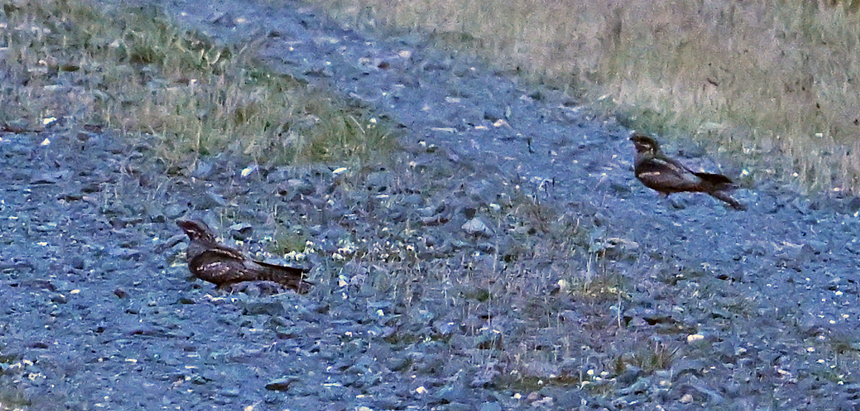
On the way back from Titchwell I called in at Cavenham Heath and Mayday Farm to do a reconnaissance for an RSPB spring walk that I was leading on the 17th. Curlew, Hobby, lots of Stonechats and (eventually) a Stone Curlew (target species) were seen at Cavenham, but the best was saved to last. When I arrived at the viewing area at Mayday Farm I was surrounded by Nightjars, some of which landed close to me on the ground, allowing me to take a few very grainy (ISO 6400) photos. I reckon that I recorded eight different birds, but there could have been more. This was quite a thrill - possibly my best bird watching experience of the year to date.

More Stone Curlews, a Woodlark and Nightjars were seen on the 17th when the group walk (an impressive 17 members) was held, but this time the 'Nightjar experience' was more routine.


Curlew, Cavenham Heath, 11 June


Two Nightjars, Mayday Farm, 11 June


'Record Shot' of a Stone Curlew, Cavenham Heath, 17 June

Earlier in the day I visited Santon Downham, hoping to get some great photos of Dragonflies and other insects along the river. The dragonflies were dominated by Banded Demoiselles (about 99% of those seen) and, as usual, they proved difficult to photograph as they moved about and kept their distance on a hot day. One of my better efforts is below. Whilst the photography did not live up to hopes, I was lucky to see a family of Crossbills as they passed me on the river, uttering their distinctive 'chip chip' calls. A family of Mandarin Ducks was also seen here.


Female Banded Demoiselle, Santon Downham, 17 June

My partner and I spent a weekend in Hampshire on the 13-15th. A walk in the New Forest was notable for the presence of hundreds of Silver-studded Blues: the New Forest is obviously a stronghold for this butterfly, and we visited at just the right time as many individuals were in good condition, some recently hatched. I also added Small Skipper butterfly and Keeled Skimmer Dragonfly to my year list during the weekend.


Silver-studded Blue, The New Forest, Hampshire, 14 June

June is a very quiet month for birds, with very few new arrivals or departures, so on the 23rd I jumped at the chance to see a Collared Pratincole, a wader that breeds in Southern and Eastern Europe, that had turned up at RSPB Frampton Marsh, near Boston. Unusually, Collared Pratincoles catch their insect prey in flight, but this individual preferred to sit on a scrubby section of one of the islands, with its back to me. It made only one brief flight in over an hour, although it did occasionally walk around a bit, revealing its unusual markings. I have recently seen Collared Pratincoles on migration in Georgia and on their wintering grounds in The Gambia, but this was my first UK sighting for over ten years. I wandered around the reserve a little and found a Little Ringed Plover sitting on a nest (which appeared to be just a hole in the mud of a low-lying island). Every time it was threatened by larger birds walking nearby and coming dangerously close to walking on the nest (Avocets, Greylag Geese) it would get up and flap its wings vigorously to try to ward them off. Unfortunately, my photographs kept missing this 'decisive moment'. Eventually the bird was relieved of its nesting duties by its partner (image).


Little Ringed Plovers at the Nest Site, RSPB Frampton Marsh, 23 June

Most of the remainder of June was spent abroad: I'll post about this holiday in due course.