I spent an afternoon at RSPB Lakenheath Fen on the 1st, looking for Water Pipits and Common Cranes. A single Water Pipit was heard, but not seen, near the Joist Fen viewpoint. Also seen were three Whooper Swans, four Great White Egrets and at least two Marsh Harriers on a quiet day.
Saturday, 9 November 2024
UK Wildlife Sightings November 2024
Tuesday, 8 October 2024
Local Wildlife Sightings October 2024
Many places to the west of Royston experienced their wettest ever September. However, for Royston (or, more particularly, my garden) September 1995 was slightly wetter - how disappointing! However, the elements hadn't finished and on the 1st well over an inch of rain fell. If September had had 31 days, it would have been the wettest month since I started recording in 1992! The impact of this horribly wet year on our wildlife has been very negative, and it was clear after all the rain that my macro lens would be of little use until next spring.
I eventually got out on the 4th, the second of two miraculously sunny days, walking up the Icknield Way (west of Royston) and later doing a 'there and back' section of the Icknield Way to the east of Royston. I didn't get as far as the Heydon Pig Farm, but saw plenty of gulls on recently ploughed fields along the way. Corn Buntings were starting to flock just over the Cambridgeshire border - I counted 13 on telegraph wires, with possibly more very distant birds. Red Admirals were the dominant butterfly, although I did see a single Meadow Brown near the house.
UK Wildlife Sightings, October 2024
I was back on the North Norfolk coast on the 2nd, researching for an RSPB Local Group trip to Holme NWT (see later), which I would be leading. There wasn't a great deal to see here - a Yellow-browed Warbler had been sighted near the car park before I arrived, but must have moved on. There was lots of activity on the lovely beach, but no rarities. I moved on to RSPB Titchwell Marsh, a few miles down the road, and was rewarded with a brief sighting of a Yellow-browed Warbler there (too dark for photography). Two others were heard at Titchwell. This species has a number of loud, distinctive calls: people usually mention the disyllabic, Coal Tit like call, but these birds were using a loud, single note call - higher pitched than the call of a Chiffchaff (of which there were many). Most of the migrating waders had moved through, but I still saw twelve species, including the Black-winged Stilt 'escape'.
A 'lifer', in the form of an Asian Desert Wheatear, turned up on the Norfolk Coast near Winterton over the weekend of the 5-6th. I was sorely tempted to 'twitch' it on the 7th, but just had too many commitments to go. Unfortunately, the bird left overnight on the 7/8th. As a consolation I decided to visit the same area on the 9th, getting great views of a very tame Hoopoe at North Walsham but missing out on Richard's Pipits at Happisburgh later in the day (they had been reported in the morning but were not subsequently seen). However, as I walked back to the car I did see yet another Yellow-browed Warbler!
Sunday, 8 September 2024
Local Wildlife Sightings September 2024
After a dry August (the first 'dry' month for nearly a year), September started unsettled, with a few rain showers and very variable temperatures, which peaked at 28C on the 1st. Royston is in one of the driest areas of the country, and this was emphasised as we missed torrential rain to the south in the first week and the constant battering of wind and rain that was endured in north-west Britain at the end of August and early September.
September sees bird migration through the country, as passerines head south towards warmer climes. Whinchats and Wheatears were reported locally in the first week, but no rarities were recorded. I was still busy photographing invertebrates, so relied on bird calls more than sightings during this period, although I did see at least three Spotted Flycatchers sallying forth from dead trees in Fox Covert to catch insects. Were these the family of birds that I saw in June and July or others passing through? I'll never know. Chiffchaffs were everywhere, sometimes appearing in parties of up to four individuals, but no Willow Warblers were heard or seen. A Raven was heard over Fox Covert on the 3rd, whilst a Green Woodpecker called nearby, the first time I've heard this species on The Heath for well over a year. A Bullfinch was heard near Royston Hospital on the 8th.
Blue butterflies became much harder to find in September, although several tatty Common Blues, a couple of Brown Arguses and a single male Chalkhill Blue were seen on the north side of Church Hill, mainly feeding on late-flowering Devil's-bit Scabious, on the 6th. No second generation Adonis Blues were seen at any time to the west of the Therfield Road: it seems very likely that this colony has, sadly, died out. Second generation Holly Blues have been few and far between this year. Perhaps the parasitic wasp (Listrodomus nycthemerus) that attacks their larvae had a successful season: these two species exist in equilibrium. The two butterflies that have done very well throughout the summer on The Heath, Meadow Brown and Small Heath, were still much in evidence: I must have seen about 50 of the former, many in good condition, on the 6th.
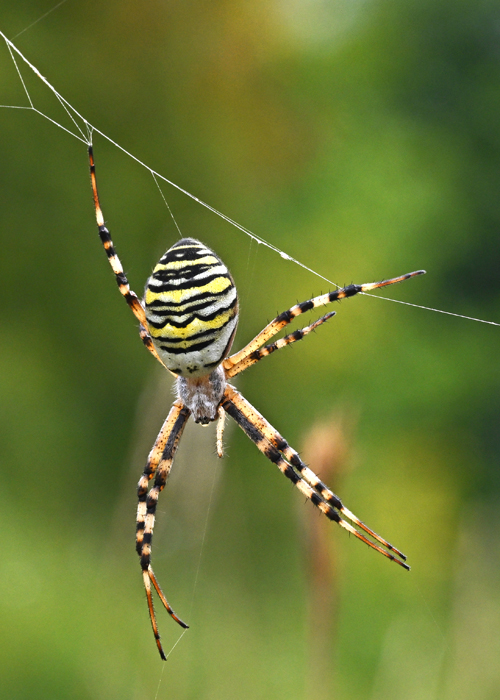
During September, my photographic interest turns towards grasshoppers, bush-crickets and spiders, all of which become far more evident as other insects disappear. I have only ever been able to find two species of grasshopper, Field Grasshopper and Meadow Grasshopper, on The Heath, whereas five species of Bush-cricket have been identified locally. This year Dark Bush-crickets and a single Roesel's Bush-cricket were the only ones seen on The Heath at the time of writing, although I am hopeful of finding more. Lots of Orb-web and female Wasp Spiders were seen, with Wasp Spiders particularly abundant at the bottom of Church Hill, where the specimens shown below were photographed.
Meadow Grasshopper, Church Hill, 3 September
UK Wildlife Sightings September 2024
When I visited Titchwell on the 4th I decided to replace the macro lens of my relatively new Nikon full-frame mirrorless camera with a brand new 100-400mm zoom lens, to check whether I would get better results photographing birds than those that I had been getting for the past 3+ years from my APS-C Nikon DSLR camera with 100-400mm zoom lens. The answer was a definite 'yes!' The birds look further away in the new combination (as expected for a full-frame camera), but heavier cropping reveals significantly more detail in the birds' feathers and a cleaner image. Further improvements could no doubt be reached by replacing the zoom lens with a very large fixed focal length lens (say 600mm F4), the only problems being a combination of an extra 2Kg of weight and an extra cost of around £12,000! Since I'm a bird watcher who just likes to take decent photos of birds every now and again, I'm very happy with the new (and, to be fair, the old) combination.
Titchwell provided me with plenty of good photographic material, particularly from inside the Island Hide, where several species of wader could be seen and glimpses of a Water Rail (my first sighting of the year) could be had. At one point a Hobby came by, causing most of the waders to fly up, before they later landed only a few feet in front of the hide - giving wonderful views for a minute or two. A Little Stint, in particular, was a very popular subject for the assembled photographers. A White-rumped Sandpiper was rather more elusive but did reveal itself later in the day, when I became marooned in the Island Hide in the middle of a thunderstorm. Elsewhere a Black-winged Stilt became the 19th wader species to be seen on the day, allowing for its rather dubious origins (apparently it was an 'escape').
My next expedition of any note was to Shelley, in Suffolk 'Constable Country', on the 12th. This turned into a rather embarrassing flop as my target bird, Purple Heron, eluded me. I found the 'flash' where it was reported to be lurking, but didn't look from the right place (a hole in a hedge, about 500M south of where I had been looking from). I should study the maps on 'Birdguides' more carefully! Still, it was a pleasant afternoon and a surprising number of species could be seen from my viewpoint.
I spent a week on holiday with my partner near Halifax from the 14th. Wildlife watching was very low on the agenda, with highlights limited to seeing a Kingfisher fly past along the River Aire in central Leeds and having a split-second view of a Dipper, again in flight, on the stream that ran past our delightful hotel.
The day after our return I visited Rye Harbour (East Sussex) by coach with my RSPB Local Group. Whilst central England (including Hertfordshire) was enjoying atrocious weather (120mm of rain over the weekend in Woburn), we were extremely lucky to spend the day walking round the reserve in dry and often sunny weather. Highlights included Spotted Redshank, a flyover Osprey, lots of Wheatears and a constant stream of Swallows, heading for Europe and thence Africa (an amazing 120,000 were recorded in the morning, nearby at RSPB Dungeness). A few of my images, taken on the trip, are shown below.
The appearance of a juvenile Red-backed Shrike at Houghton Regis, near Dunstable, encouraged me out of the house on an otherwise appallingly dull and wet week, on the 24th. This time I came armed with an exact knowledge of where the bird was showing, and was rewarded with good views as it moved around between bushes, close to a stream. A couple of Stonechats were also present here - I wonder whether they would be too large for the Shrike to catch.....